Understanding the Digital Divide in America
When people hear the phrase digital illiteracy, many assume it only affects developing countries. But the reality is that millions of people across the United States still struggle with basic digital skills.
In today’s digital world, almost everything happens online:
- Job applications
- School assignments
- Healthcare services
- Banking transactions
- Business marketing
- Communication and networking
Yet many Americans still lack the knowledge, tools, or confidence to fully participate in this digital society.
This growing issue is known as the digital divide, and its effects are deeper than most people realize.
How Digital Illiteracy Affects Employment Opportunities
One of the biggest consequences of digital illiteracy in the USA is unemployment and limited career growth.
Most companies now require applicants to:
- Submit resumes online
- Use email professionally
- Attend virtual interviews
- Operate digital workplace tools
For individuals without these skills, even finding a job can feel overwhelming.
A talented person may be qualified for a position but still lose opportunities simply because they don’t know how to navigate online systems.
As remote work, freelancing, and hybrid jobs continue to grow in 2026 and beyond, digital literacy is becoming one of the most important employability skills in America.
Education Barriers Created by the Digital Gap
Technology has completely transformed education in the United States.
Today’s students are expected to:
- Access online learning platforms
- Submit assignments digitally
- Conduct internet research
- Communicate through educational apps and email
But not every student has equal access to technology or digital training.
Students from underserved communities often face:
- Limited internet access
- Lack of laptops or devices
- Low digital confidence
- Reduced learning opportunities
Over time, these challenges create educational inequalities that affect future career success.
The digital gap doesn’t just affect students academically, it impacts confidence, independence, and long-term opportunity.
Small Businesses and Entrepreneurs Are Also Struggling
Digital illiteracy doesn’t only affect students and job seekers. Many small business owners across the USA also struggle to adapt to today’s digital economy.
Without digital skills, businesses may experience:
- Low online visibility
- Weak social media presence
- Difficulty attracting customers
- Poor online communication
- Challenges with e-commerce and digital payments
In a competitive economy, businesses that cannot operate online often fall behind.
Digital literacy has become essential for entrepreneurship, marketing, customer engagement, and business growth.
Why Digital Literacy Matters More Than Ever
Digital literacy is more than knowing how to use a computer.
It’s the ability to:
- Access information
- Communicate effectively
- Solve problems using technology
- Work confidently in digital environments
- Compete in modern industries
In many ways, digital literacy now determines who has access to opportunities and who gets left behind.
People without digital skills often experience:
- Social exclusion
- Reduced employment opportunities
- Limited educational growth
- Financial challenges
- Lower confidence in professional settings
This is the hidden cost of digital illiteracy.
How Organizations Are Helping Close the Gap
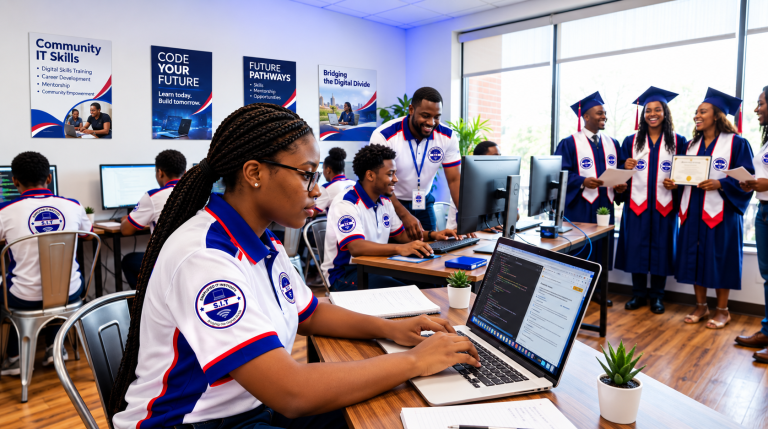
Organizations like Simplified IT Institute (SIT) are helping bridge this divide by providing accessible digital education and community support in both the USA and Cameroon.
Their programs focus on:
- Digital literacy empowerment
- Education and training sponsorship
- Internship support
- Mentorship programs
- Donation of computers and ICT kits
- School material support
These initiatives help individuals gain practical skills that improve both personal and professional growth.
The Ripple Effect of Digital Education
When one person gains digital skills, the impact spreads far beyond the individual.
Families become more connected.
Students perform better in school.
Businesses grow online.
Communities become more informed and empowered.
Digital education creates opportunities that can transform entire communities.
The Future Belongs to the Digitally Skilled
As technology continues to evolve, digital literacy is becoming just as important as reading and writing.
The future workforce will depend heavily on:
- Technology skills
- Online communication
- Digital collaboration
- Remote work readiness
Communities that invest in digital education today will be better prepared for tomorrow’s opportunities.
Final Thoughts
“The hidden cost of digital illiteracy is not just missed opportunities, it’s unrealized potential.”
In a world driven by technology, access to digital skills should not be a privilege. It should be an opportunity available to everyone.
By investing in digital literacy, we invest in stronger communities, better opportunities, and a more inclusivehnology is constantly evolving, which means learning never truly stops, and that’s a good thing.
Learn more about Simplified IT Institute:
www.simplifieditinstitute.org/about-us
Support digital skills training and youth empowerment:
www.simplifieditinstitute.org/donate